Posts

Showing posts with the label training plan

The speed training and other myths that are slowing you down
Image
Speed training is an essential component of performance in many racing sports but it is often butchered. Ideas, methods and personal opinions of training schemes and speed training methods that are not supported by science or consistent results are still far too common. I thought it may be fun to outline below a few myths related to endurance and speed-endurance in sports including kayaking and how these may actually block you from progressing and getting faster. Myth 1 : Higher average speed at training days or races means you are getting faster Being able to generate faster speeds for a longer time may increase your average speed or even top-end speed on a training day or during a race. Observing such metrics is not a bad idea, however, these should be put in the right context and within a carefully outlined training plan. They should be part of monitoring progress in the long haul and not be indicative of performance (either personal or boat-specific) during random training days or...

What's up for 2017

Image
My goals for 2017 summarized in two sentences: I am racing my first marathon and I am aiming for a top place at the 2017 ITU long-course World Championships! After sitting down and assessing the 2016 season, Dave asked me the magic question: what do you want to do in 2017? I said, I felt I had a good race at the 2016 ITU long-course World Championships, but for some reason, I have an unfinished business out there. I did well but I did not feel I raced the race. So, we looked at the data and he decided that I lacked running training...he actually said that my 19mi run at the Worlds was not as bad as I thought to be taking into account my 20-25 mi weekly averages during my preparation. Dave said that the best way to put some volume on the run and let your body adapt to longer distances and that way be ready for speed work in spring/summer is to prepare for a marathon race. So, we divided the season into four chunks: 1. Pre-marathon volume build: Run : increase the weekly volume s...

USAT Long Course National Championships ~ my qualification for the World Championships

Image
All it takes is a lot of patience, practice, smart preparation, a good strategy, a good nutrition plan, an intelligent coach and an athlete who listens and executes. Patience : 3 1/2 years since I completed a major race (4th at the Collegiate Nationals in 2012) without any pain in my abdominal muscles (see: New 2015 season. Shaping up, building up and racing pain-free )  Practice : I never stopped working out during the past 3 years. I couldn't run for two years but I biked a lot and worked religiously on my swim! Smart preparation : We only had 8 weeks. I lacked running volume and we increased the mileage very slowly but steadily up to one week before the race. Because we did not do any running intervals, all the intensities (endurance threshold, aerobic/anaerobic and VO2 max workouts) were done in the water (swimming).  Good strategy : My racing plan was very specific: do your best in the swim, take it out a little slower and negative split on the ...

New 2015 season. Shaping up, building up and racing pain-free

Image
My new season is slowly getting into a proper routine of training and preparing for 2015. My dear Lord, it has been a long two-year anticipation of trying to resolve my abdominal pain mystery (see Shaping up for 2015 ). I am really excited to have that finally under control and be able to work around it, train successfully and plan for the upcoming months. I have been working on my swimming technique (see The path to becoming a more efficient swimmer ) and I have also been putting long miles on the bike. My running is still at a base-line as I only started running again a month ago. I have had some test-fitness races earlier this month. These races showed that my fitness is at a good level, both endurance-wise (3rd at the first round of the southeast endurance 6hr solo mtb cup) and speed-wise (3rd at the annual 11mi Cumming TundraTT). Cumming Tundra TT podium South-East Championships (round#1)  6hr solo mtb podium For the coming months, the plan includes a gradual...

Faster running times: Negative splitting

Image
If you want to run a faster 5K or a marathon or just get better in the running leg of a triathlon you gotta learn to tune with your body and understand what is often called, perceived effort. The majority of the runners out there start out a little faster than they can maintain over the course of the race and gradually slow down their pace or fade out. They may run a fast time this way but the question is: could it be faster with negative splitting? There has been lots of discussion on the subject over the years and there are lots of examples on elite athletes racing with different strategies. Excluding the exceptions (exceptions always exist to general rules) most records have been broken either by even splitting or negative splitting. The latter is what describes the time of the second half being faster than the time of the first half. And this is hard to accomplish. Understanding how fast you should go during the first half so that you can save a tiny bit to run the second ...

A mature athlete has the right mindset

Image
Maturing as an athlete is a lot more than just getting faster or becoming more efficient. I believe that what makes an athlete mature is a great mindset.  From my own small-world perspective, my athletic attitude has changed dramatically over the years. I remember my first season that started in October 2011: I was restless. I wanted to train every day. The more the better. I was getting excited with every little success, from clocking faster 5K times every month to winning the smallest local race in town. I was also getting depressed easily: whenever my knee was hurting or my shoulder was pinching. I was becoming really pessimistic if I had to take time off training in order to deal with smaller or bigger injuries. I remember I was crying for days when I had to stop swimming for nearly 4 months to rehab my left shoulder from chronic rotator cuff injury: I went to the 2012 Collegiate Nationals having practiced 0 swimming for 4 months (I finished 4th overall). The majo...

How it feels during the progressive overload training period

Image
Let's first make something clear: Before you jump into an overload training phase, you need to have a coach who understands very well the concept behind the periodization training plan and who can apply it specifically to you and adjust it along the way depending on the circumstances and your unique, personal needs. You can read more about it in one of my previous posts here: The porgressive overload as part of a periodization training plan When it's time to enter the progressive overload period of my training plan, I have just come out from the base and transition periods. The former (base) requires lots of slow, long miles and the latter (transition) lots of sort, power exercises that make different muscle groups work one after the other. Before the overload period, I probably weigh 2 to 4 pounds more, I feel a little tired but not worn out, and I may (or may not!) get a week of easy workouts: every day I would do about 1 hour of easy spin or 20min of jogging or 45m...

Training for fitness or training for performance?

Image
I used to think that training to perform at your best will also make you look and feel fit all the time. Well, this is not quite true. At the 2011 Intercollegiate National Cross Country Championships An extreme example to what I am going to talk about in this post can be found in the bodybuilders. The sport of bodybuilding has a really tough lifestyle. The athletes have to balloon in size  most of the year and then trim down dramatically during competition. Most of the year they just look like really fat people. Do you have any idea what it takes in terms of nutrition, exercise and ability to combat with emotional swings in order to be a successful bodybuilder? It turns out that elite endurance athletes, who train and taper to compete in a way similar to bodybuilders, face similar challenges: they don't have to bulk up and then trim down to compete but instead, they have to build up and then go fast. They are not happy all the times and they certainly do not look fit and...

Power Test using CycleOps and PowerTap

Image
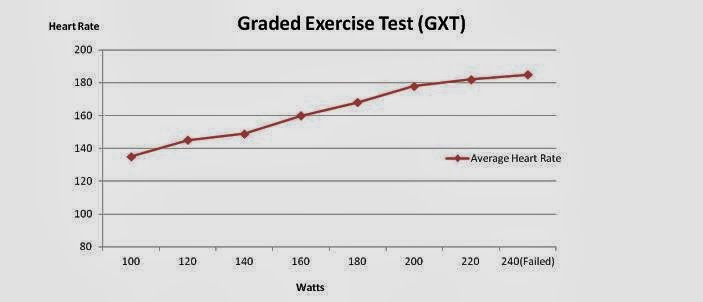
December 28, 2013 By coach Dave Williams The Graded Exercise Test (GXT) is a measure of cardiovascular fitness.  It shows your body’s response to increasing workload.  It can also identify lactate threshold wattage and heart rate.  A plot of HR versus power shows the cardiovascular response to increasing workload.  The lactate threshold is about 10-15% below the point where breathing becomes labored.  The corresponding perceived exertion would be about 7 out of 10.  An ideal improved training response would indicate each power step achieved at a lower heart rate and lactate threshold reached at a higher wattage with an increase in peak power achievement.  Ideally the plotted line should shift down and to the left as fitness improves.  [HR: Heart Rate; RPE:Rate of Perceived Exertion; Ventilations: E(easy), F(fast), H(hard), L(labored)] GXT Test: December 28, 2013 Lactate Threshold Heart Rate: LTHR 167 Lactate Thre...

Choosing the right goal

Image
Finding the right coach or finding the right athlete and the right program for achieving your athletic goals can be challenging. I believe that the most challenging part for both the athlete and the coach is to set up a goal. A long-term goal (some years in the future) and a short-term goal (at the end of the season) - the latter will be part of the former. A coaching plan is a plan. And a plan is made to serve a purpose, a goal. A goal that has to be precise, measurable and challenging but also achievable. Once the goal is set, then the path to get there can be decided. There are many ways one can get to their goals. I am not an expert to say definitively which way is the best. The choice is up to the athlete and the coach. As long as there is trust between the two, trust in the goal and the outlined plan, good chemistry, enthusiasm, work ethic and passion, there will always be multiple ways to accomplish that goal and succeed. I know many athletes who do not have a goal an...